

Language Development in Toddlers: What’s Normal and What Helps
The toddler years are full of exciting firsts. Children begin to walk, explore their surroundings, and start using words to express what they want or feel. For many parents, one of the most fascinating parts of this stage is watching language development in toddlers unfold day by day. One week your child might say a few single words, and soon after they may begin combining one or two words to share ideas.
This article is written for parents, caregivers, and family members who want to better understand how language development typically progresses between 12 and 36 months. The goal is simple. We want to help you recognize what is normal, learn practical ways to encourage language, and know when it may be helpful to speak with a professional.
Most importantly, we want parents to feel confident. Every child develops at their own rhythm, and there are many simple ways adults can support a child’s growing communication skills at home.
Speech and Language Development Overview
The early years are an incredible time for speech and language development. A child’s brain is rapidly building connections, and everyday interactions with parents and caregivers help shape how children communicate.
Typical Milestones From 12 to 36 Months
Between the first and third birthday, most children move through several recognizable stages of language development.
At around 12 months, many toddlers say their first words. These might include names like “mama” or “dada,” or labels for common objects such as “ball” or “cup.” At this stage, babies may also point to a familiar object while making a sound to get attention.
By 18 months, toddlers often begin adding more words. Some may have 10 to 20 new words, and they frequently use gestures, facial expressions, and body language to help communicate meaning.
By 24 months, vocabulary typically grows quickly. Many toddlers combine one or two words into short phrases, like “more milk” or “big truck.” These early sentences may sound simple, but they represent an important step in speech and language.
Between 2 and 3 years, children develop longer sentences, learn new vocabulary words, and begin asking simple questions. They also become more interested in stories, songs, and conversations with adults.
Variability Between Children
Even though there are general milestones, it is important to remember that toddlers learn at different speeds. One child might start speaking early while another takes more time but quickly catches up later.
These differences are completely normal. Language development depends on many factors, including personality, environment, and how much opportunity children have to talk, listen, and play.
Cultural Influences on Timelines
Culture can also influence how children develop language. In some families, children hear multiple languages daily. In others, extended family members regularly participate in conversations and storytelling. These experiences may shape when children begin to talk and how they use words.
When to Consult a Pediatrician or Speech Therapist
If parents have concerns about a child's speech or notice that their child rarely attempts to communicate, it is wise to consult a pediatrician or a speech language therapist. Early guidance can provide reassurance and help support speech and language development if needed.

Key Language Skills to Track
Tracking a few key language skills can help parents see how a child’s abilities are growing.
Receptive Language Indicators
Receptive language refers to what a child can understand.
Signs of receptive language skills include:
- Responding when someone says their name
- Following simple instructions such as “bring the ball”
- Looking at a familiar object when it is named
- Pointing to pictures in a book when asked
At this stage, toddlers may understand far more words than they can say.
Expressive Language Indicators
Expressive language skills involve what a child can say or communicate.
Examples include:
- Saying first words
- Adding new words each week
- Combining phrases or short sentences
- Attempting to label objects, pictures, or people
Watching these changes over time helps parents see how a child’s vocabulary and speaking abilities develop.
Gesture Milestones
Before children rely fully on spoken language, they often use gestures.
Examples include:
- Pointing to request something
- Waving goodbye
- Shaking the head for “no”
- Using facial expressions to show excitement or frustration
Gestures help toddlers communicate effectively before they have the words they need.
Play Milestones
Play is deeply connected to language development.
During play, children:
- Label objects
- Practice turn taking
- Pretend to feed dolls or drive toy cars
- Create short stories with toys
These playful moments help children practice language in a natural and enjoyable way.
Practical Strategies to Boost Language Development
The good news for parents is that everyday routines provide many opportunities to strengthen a child's language skills.
Model Slightly Longer Sentences’
One helpful approach is to model slightly longer sentences than the child uses.
Example
Child: “Truck.”
Adult: “Yes, that is a big truck.”
This simple expansion introduces more words while keeping the conversation easy to understand.
Expand Child Phrases
Another technique is to build on a child’s phrases.
Child: “Dog bark.”
Parent: “The dog is barking loudly.”
These expansions help introduce new vocabulary words in a natural way.
Narrate Daily Routines
Narrating daily routines helps children connect words to real experiences.
Parents might describe activities like bath time, cooking, or putting toys away.
Example:
“Now we wash your hands. The water is warm.”
These everyday explanations help toddlers connect language to the world around them.
Pause to Allow a Response
After speaking, pause and listen. Toddlers often need time to process language and respond.
A brief pause signals that the conversation is shared.
Offer Choices
Choices encourage children to communicate.
Example:
“Do you want the apple or the banana?”
The child may point, say a word, or attempt a short response. All forms of communication count as practice.
Encourage Communication Skills Through Play
Playful interaction is one of the most effective ways to support language development.
Turn Taking Games
Simple games that involve turn taking encourage conversation.
Rolling a ball back and forth is a great example.
Parent: “My turn.”
Child: “Turn.”
These exchanges strengthen early communication skills.
Pretend Play
Pretend play helps children introduce labels and describe actions.
For instance, a toy kitchen can inspire short stories.
“Baby is hungry.”
“Let’s cook soup.”
Children often become deeply interested in these imaginative scenarios.

Using Toys to Prompt Requests
Parents can place a desired toy slightly out of reach so the child needs to communicate.
The child might point, attempt a word, or look toward the adult.
These moments naturally encourage children to talk.
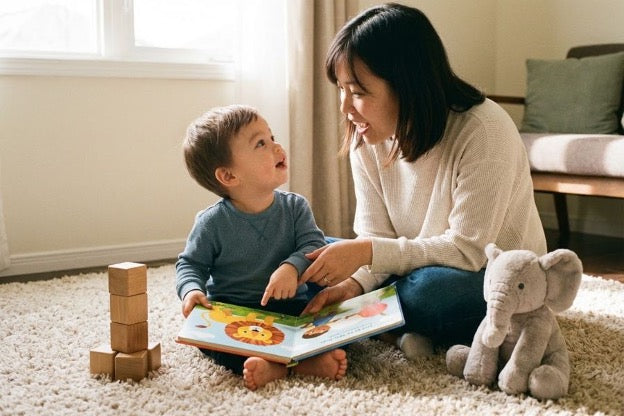
Explore Books to Teach New Words
Daily reading is one of the most powerful tools for language development.
Many toddlers love looking at pictures and hearing familiar stories again and again.
Read Aloud Every Day
Short daily reading sessions help children understand language patterns.
Children often enjoy returning to the same page of a book because repetition helps them practice.
Encourage Pointing to Pictures
Parents can ask the child to point to items in the book.
“Where is the dog?”
This encourages toddlers to connect words with objects.
Name Objects in Books
Encourage the child to say the name of an object.
If they attempt a sound, respond warmly and repeat words clearly.
Repeat Target Words
Repetition helps the child's mind store new words.
Children love hearing the same labels in familiar stories.
Add Interactive Actions
Adding actions during reading keeps toddlers interested.
For example:
- Clap during exciting moments
- Make animal sounds
- Pretend to jump or stomp
These playful actions make books more fun and memorable.
Use Open Ended Questions to Expand Language
As children grow, caregivers can gently expand conversation by asking open ended questions.
Examples of Prompts
Instead of yes-or-no questions, try prompts like:
- “What do you see in this picture?”
- “What do you think the dog will do next?”
- “How does the baby feel?”
These prompts encourage children to talk more.
Pause After Asking
Give toddlers time to respond. Silence can feel long, but it gives the child space to organize language.
Expand Responses
If a child answers “dog,” the adult can add more words.
“Yes, the dog is running fast.”
This helps build longer sentences.
Speech and Language Development Activities
Parents often ask for structured activities that help support speech and language development.
Here are several simple options.
Building Block Language Games
Stacking blocks can become a language activity.
Parents might say:
“Blue block.”
“Big block.”
“Block falls down.”
These descriptions introduce new words while keeping play fun.
Role Play Scripts
Pretend play with dolls or animals allows caregivers to model conversation.
Example:
“Hello baby.”
“Baby is sleepy.”
“Let’s read a story.”
These small stories help toddlers understand how conversations work.
Song Activities
Songs are excellent for language development because rhythm makes words easier to remember.
Examples include:
- Action songs with clapping
- Movement songs with jumping
- Animal songs with playful sounds
Music also encourages speaking and imitation.
Obstacle Tasks That Prompt Requests
Set up a simple obstacle path using pillows or boxes.
Pause during the activity so the child must request help.
The child may point, say a word, or attempt a phrase.
These moments create meaningful opportunities to communicate.
Caregiver Prompting Examples
Caregivers can model language naturally.
Examples include:
- “Tell me more.”
- “What is that?”
- “Can you show me?”
These prompts gently encourage conversation.
Monitoring New Words and Progress
Tracking new words can help parents see steady progress in language development.

Track Vocabulary Weekly
Many caregivers enjoy keeping a small notebook.
Each week, write down the words the child uses.
Watching the list grow can be encouraging for parents and children.
Simple Milestone Checklist
A basic checklist may include:
- Says first words
- Combines one or two words
- Points to objects when named
- Enjoys stories and songs
This approach helps parents monitor development without pressure.
Referral Criteria
If a toddler shows very slow growth in vocabulary or rarely attempts to communicate, it may be helpful to consult a professional.
Early guidance can provide valuable support.
When To Seek Help For Speech And Language Development
Sometimes parents notice signs that may require evaluation.
Possible Red Flags
Parents may consider professional guidance if a child:
- Rarely attempts to talk
- Does not respond to simple requests
- Uses very few words by age two
- Shows frustration when trying to communicate
These signs do not always mean there is a serious problem, but a professional evaluation can help identify next steps.
Accessing Speech Language Services
Parents can begin by speaking with their pediatrician.
The pediatrician may recommend:
- A hearing test
- A developmental screening
- Referral to speech therapy
Early support often helps children develop language more confidently.
Resources And Next Steps
Parents who want to learn more about language development can explore several helpful resources.
Many pediatric organizations provide printable handouts that explain language milestones and communication strategies.
Caregivers may also benefit from practical toolkits that include:
- Play-based language activities
- Printable milestone charts
- Conversation prompts for stories and daily routines
Future topics parents often ask about include:
- How to encourage speaking in picky eaters
- Language growth in bilingual homes
- Social communication during preschool years
At Tiny Wins, we often hear from parents who notice their kids becoming more curious and eager to talk as they grow. In our experience working with families, simple routines like shared meals, reading stories, and playful conversations create a nurturing environment where children feel comfortable exploring language.
Healthy daily habits also support a child’s overall development. When kids feel energized and supported, they are more interested in interacting with the people and objects around them.
Watching a child discover new words, connect ideas, and express their thoughts is one of the most joyful parts of parenting. With patience, play, and encouragement, language development becomes a natural part of everyday family life.


Leave a comment
This site is protected by hCaptcha and the hCaptcha Privacy Policy and Terms of Service apply.