

Table of Contents
- Why Natural Fiber Alternatives Matter for Kids
- Understanding Soluble and Insoluble Fiber
- High Fiber Foods That Actually Work
- Fruits and vegetables for picky eaters
- Fiber Intake for Kids by Age: How Much Do They Really Need
- How to Help a Constipated Child Naturally
- Fiber-Rich Recipes for Kids Who Refuse Most Foods
- When Food Alone Isn't Enough: Whole-Food Powders vs. Supplements
- Frequently Asked Questions
Why Natural Fiber Alternatives Matter for Kids
Most children can meet their fiber needs through whole foods, the challenge is finding natural fiber alternatives for kids that picky eaters will actually consume.
Understanding Soluble and Insoluble Fiber
Soluble fiber dissolves in water and forms a gel-like substance in the digestive tract. It feeds beneficial gut bacteria and helps regulate blood sugar. Insoluble fiber doesn't dissolve and adds bulk to stool, promoting bowel regularity.
High Fiber Foods That Actually Work
Whole grains and legumes
Whole grains deliver fiber without tasting "healthy." Mix brown rice into white rice (start at 25%, increase slowly) or blend whole wheat pasta with regular pasta.
Fruits and vegetables for picky eaters
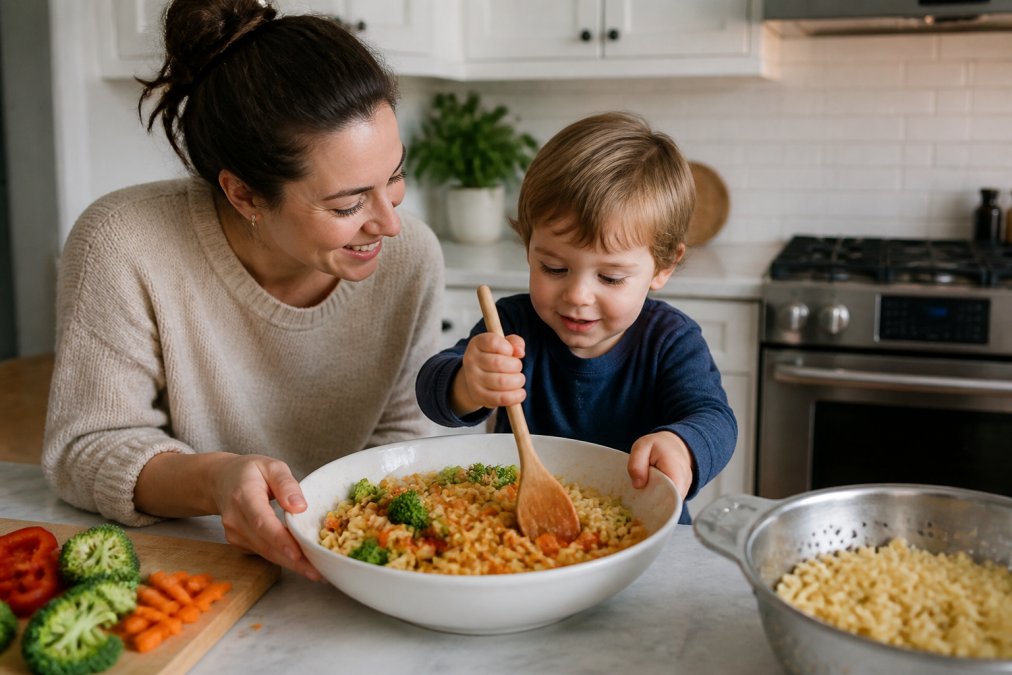
Fruits naturally appeal to kids because they're sweet. Berries, pears, and apples deliver significant fiber; the skin contains most of it. Cooked vegetables are softer and more acceptable than raw for many kids. Roasted sweet potato, steamed zucchini, and soft-cooked peas disappear into pasta, rice bowls, or ground meat dishes.
Fiber Intake for Kids by Age: How Much Do They Really Need
Toddlers ages 1-3 need about 19 grams of fiber daily; children ages 4-8 need 25 grams; kids ages 9-13 need 26-31 grams. A medium apple provides 4g, beans deliver 6-8g, and whole wheat bread offers 3-4g per slice. Most American children fall short, but adding one high-fiber food to each meal closes the gap within weeks. Younger children need gentler introduction, start with small amounts of soluble fiber and increase gradually over 2-3 weeks.
How to Help a Constipated Child Naturally
Constipation usually signals insufficient fiber and inadequate hydration. Introduce fiber gradually so your child's digestive system adapts without triggering cramping and gas.
The 'Start Low, Go Slow' protocol: Week-by-week timeline
Week 1: Establish baseline
- Day 1-3: Track bowel movements, water intake, and digestive complaints.
- Day 4-7: Introduce ONE fiber source (e.g., half a medium apple at breakfast or 1 tablespoon beans mixed into lunch). Pair with an extra 4-8 oz of water daily.
Week 2: Add a second source
- Day 8-14: Add a second fiber source at a different meal (e.g., beans or lentils at lunch if Week 1 was fruit at breakfast). Start with 1-2 tablespoons of pureed or mashed legumes.
- Increase water intake by another 4-8 oz daily (8-16 oz total from baseline).
- Most children show softer stools or more regular bowel movements by Day 10-12.
Week 3: Gradual increase
- Day 15-21: Increase portion sizes (half apple to whole apple; 1 tablespoon to 2 tablespoons of beans) or add a third fiber source.
- By Day 21, most children reach 1-2 soft bowel movements daily.
Week 4 and beyond: Maintenance
- Aim for fiber from at least three different sources daily (fruit, vegetable, whole grain, or legume).
- Maintain consistent water intake.
Age-specific serving sizes and adjustments
Ages 1-3 (Toddlers)
- Start with: 1-2 tablespoons of soft fruit or 1 tablespoon of pureed beans daily.
- Water baseline: 4 cups daily; increase by 4-8 oz during introduction.
- Timeline: 3-4 weeks due to smaller digestive capacity.
- Best sources: mashed fruit, pureed legumes, soft-cooked vegetables.
Ages 4-8 (Early school-age)
- Start with: 1/4 cup fruit or 2 tablespoons of beans daily.
- Water baseline: 5 cups daily; increase by 8-12 oz during introduction.
- Timeline: 2-3 weeks.
- Best sources: whole fruits, soft-cooked vegetables, whole grain bread (start with 25% whole wheat blended with white).
Ages 9-13 (Older children)
- Start with: 1/2 cup fruit or 1/4 cup beans daily.
- Water baseline: 6-8 cups daily; increase by 12-16 oz during introduction.
- Timeline: 2 weeks.
- Best sources: whole fruits with skin, raw vegetables, legumes, whole grains.
Troubleshooting: What to do if cramping or gas occurs
If your child complains of stomach pain, bloating, or excessive gas:
- Pause and hold: Stay at the current fiber level for 5-7 days before increasing.
- Check hydration: Increase water intake by 4-8 oz. Inadequate water is the #1 cause of cramping.
- Assess portion size: Reduce the most recent fiber source by half and reintroduce more slowly.
- Switch the source: If beans cause excessive gas, try fruit or whole grains instead.
- Timing: Spread fiber sources across meals rather than concentrating them at one meal.
- Contact your pediatrician: If cramping persists beyond 7 days, or if your child develops diarrhea, worsening constipation, or signs of dehydration (dark urine, dry lips).
Hydration and bowel regularity
Fiber without water creates harder stools, not softer ones. Soluble fiber needs liquid to form that beneficial gel. Young toddlers need roughly 4 cups of water daily; older children need 5-8 cups. During fiber introduction, increase water intake by 1-2 cups above baseline. Make hydration appealing with a special cup, a splash of fruit juice, or offering water during specific activities.
Fiber-Rich Recipes for Kids Who Refuse Most Foods
Black Bean Pasta: Mix cooked black beans into pasta sauce (50/50 ratio initially). Adds 6-8g fiber per serving. Sweet Potato Pancakes: Blend cooked sweet potato into pancake batter (3-4g fiber per serving). Lentil Meatballs: Combine cooked lentils, ground meat, and breadcrumbs; serve with marinara. Chickpea Brownies: Pureed chickpeas replace some flour (4-5g fiber per brownie). Fruit-Grain Muffins: Mix berries or mashed banana into whole grain batter; start with 25% whole wheat flour. Veggie Mac and Cheese: Puree cooked vegetables into the cheese sauce.
Recipe |
Fiber per Serving |
Best For |
Time to Prepare |
|---|---|---|---|
Black Bean Pasta |
6-8g |
Kids who eat pasta |
15 minutes |
Sweet Potato Pancakes |
3-4g |
Breakfast resistance |
20 minutes |
Lentil Meatballs |
5-6g |
Meat-loving kids |
25 minutes |
Chickpea Brownies |
4-5g |
Dessert-focused kids |
30 minutes |
Fruit-Grain Muffins |
3-4g |
Snack refusers |
25 minutes |
Veggie Mac and Cheese |
4-5g |
Cheese lovers |
20 minutes |
When Food Alone Isn't Enough: Whole-Food Powders vs. Supplements
Children with extremely restricted diets, severe sensory sensitivities, or malabsorption issues may need whole-food powders. Before introducing any fiber supplement, understand how fiber interacts with medications and other supplements.
Fiber and medication interactions: What parents need to know
How fiber affects absorption: Soluble fiber can bind to medications in the digestive tract, reducing absorption. This is most relevant for:
- Iron supplements: Fiber can reduce iron absorption by 20-30% if taken at the same time. Solution: Give iron supplements 1-2 hours before or 4 hours after fiber-rich meals.
- Calcium supplements: Fiber can interfere with calcium absorption. Solution: Separate calcium and fiber intake by at least 2 hours.
- Certain medications for ADHD, thyroid conditions, or antibiotics: Fiber can delay stomach emptying. Solution: Check with your pediatrician or pharmacist about timing.
- Multivitamins: Separate from fiber supplements by at least 2 hours.
What to do:
- List all supplements and medications your child takes.
- Ask your pediatrician or pharmacist: "Does fiber affect absorption of any of these?"
- If yes, establish a timing schedule. Example: Iron supplement at breakfast, fiber-rich lunch at noon, calcium supplement at dinner (2+ hours after fiber).
- A pharmacist can help create a schedule if your child is on multiple medications with absorption concerns.
Whole-food powders vs. synthetic fiber supplements: Which works for picky eaters
Whole-food powders:
- Made from dehydrated fruits, vegetables, or grains.
- Taste like the source ingredient (apple powder tastes like apple).
- Blend invisibly into foods without grittiness or flavor change.
- Contain fiber plus vitamins, minerals, and phytonutrients from the whole food.
- Best for: Kids with sensory sensitivities, extreme pickiness, or food aversion.
Synthetic fiber supplements (psyllium, methylcellulose, inulin):
- Isolated fiber extracted from plants or synthesized.
- Taste medicinal or slightly bitter (psyllium husk especially).
- May feel gritty or change texture of foods.
- Contain fiber only, no additional nutrients.
- Best for: Kids without sensory sensitivities who can tolerate the taste, or when cost is the primary concern.
Hybrid option: Inulin-based powders Inulin is a soluble fiber extracted from chicory root or agave. It's flavorless and dissolves completely, making it invisible in foods. However, inulin can cause bloating and gas in some children because it ferments in the colon. If your child experiences excessive gas with inulin, switch to a whole-food powder or reduce the dose.
Dosage safety by age and supplement type
Dosing varies by product. Always follow label instructions for your child's age:
Ages 1-3:
- Whole-food powders: 1/2 to 1 teaspoon daily, mixed into food.
- Synthetic supplements: Generally not recommended; whole foods are safer and more effective.
- Maximum: Do not exceed 1 teaspoon daily without pediatrician approval.
Ages 4-8:
- Whole-food powders: 1-2 teaspoons daily, divided between meals.
- Synthetic supplements: Start with 1/2 teaspoon daily; increase gradually.
- Maximum: 2-3 teaspoons daily (equivalent to roughly 5-8 grams of fiber from the supplement).
Ages 9-13:
- Whole-food powders: 1-3 teaspoons daily, or follow label instructions.
- Synthetic supplements: 1-2 teaspoons daily, or follow label instructions.
- Maximum: Follow label instructions; most products recommend 1-2 servings daily.
Ingredients to avoid in kids' fiber supplements
Read the label carefully. Avoid supplements containing:
- Artificial sweeteners (aspartame, sucralose, saccharin): May cause digestive upset or behavioral sensitivity in some children.
- Sugar alcohols (sorbitol, xylitol, maltitol): Can cause bloating, gas, and diarrhea, especially in children under 8.
- Artificial colors or flavors: Unnecessary and may trigger sensitivities.
- Added sugars: Defeats the purpose of adding nutrition; look for "0g added sugar" on the label.
- Gums or thickeners (guar gum, xanthan gum): Can cause bloating if your child is sensitive; whole-food powders typically don't need these.
Look for supplements with:
- Real fruit, vegetable, or grain as the first ingredient.
- No added sugar or sugar alcohols.
- Minimal ingredients (5 or fewer).
- A third-party tested seal if available.
The key question: Does your child need a supplement?
If whole foods work, stick with them. If sensory resistance or restrictions make whole foods impractical, a quality whole-food powder bridges the gap without battles.
Before starting any supplement, confirm with your pediatrician that:
- Your child actually needs additional fiber (not all constipation is caused by low fiber).
- The supplement won't interfere with any medications or other supplements.
- The dosage is appropriate for your child's age and weight.
Frequently Asked Questions
What are the best natural fiber sources for picky eaters?
Whole-food powders made from fruits, vegetables, and grains blend invisibly into foods kids already eat—pasta, applesauce, yogurt, and chicken nuggets. Pectin from fruits, beta-glucans from oats, and inulin from chicory root are soluble fibers that don't change taste or texture. Start with familiar foods and add fiber gradually. Tiny Wins powders, for example, are designed to be tasteless and work in both sweet and savory meals, so your child gets fiber without detecting it.
How much fiber does a child actually need by age?
The recommended daily fiber intake for kids is age plus 5 grams. A 3-year-old needs about 8 grams per day; a 6-year-old needs roughly 11 grams. Most children fall short by 5–10 grams daily. Whole foods—beans, oats, berries, and vegetables—are the best sources. If your child's diet is very restricted, a third-party tested whole-food powder can bridge the gap safely without overwhelming their digestive system.
How do I know if my child needs more fiber?
Signs include infrequent or hard stools, straining during bowel movements, bloating, or complaints of stomach discomfort. Children eating mostly refined foods—white bread, pasta, chicken nuggets—typically need more fiber. If your child is constipated or has inconsistent bowel regularity, gradually increasing soluble and insoluble fiber through whole foods or a tasteless powder can improve gastrointestinal motility and stool consistency without the side effects of over-the-counter supplements.
Can whole-food fiber powders really work for kids with extreme sensory sensitivities?
Yes, if they're truly tasteless and don't alter texture. Third-party tested powders made from real fruits, vegetables, and whole grains dissolve completely into foods without changing mouthfeel. The key is choosing products specifically formulated for children with sensory aversions—no grit, no aftertaste, no artificial ingredients. Start with a tiny amount mixed into a favorite food, then gradually increase. Parents report success mixing these powders into pasta sauce, applesauce, yogurt, and even chicken nuggets without their child detecting any change.


Leave a comment
This site is protected by hCaptcha and the hCaptcha Privacy Policy and Terms of Service apply.