
Quick Summary
Managing dinner time anxiety in children starts with recognizing that refusing food is often a fear response, not defiance. Reduce pressure at the table with a predictable routine, familiar foods served alongside new ones, and no forced bites, and seek professional help if meals cause ongoing distress or growth concerns.
- Watch for crying, gagging, freezing, or repeated safety questions before the first bite.
- Keep meals about 20 to 30 minutes with a consistent start and end.
- Use the look, touch, taste ladder and accept whatever step the child stops at.
- Praise exploration like touching or smelling food, not just eating.
- See a pediatrician if weight drops, the accepted food list shrinks, or meals cause daily distress.
Table of Contents
- Common signs and triggers at the dinner table
- How to Reduce Stress at Mealtimes With Kids
- A Step-by-Step Plan for an Anxious Dinner
- What to Say to a Picky Eater (and What to Avoid)
- Food Exposure Activities for Children Who Feel Nervous About Food
- When to Seek Help for Picky Eating and Mealtime Anxiety
- Booking Your Child's Next Steps With a Feeding Professional
- Frequently Asked Questions
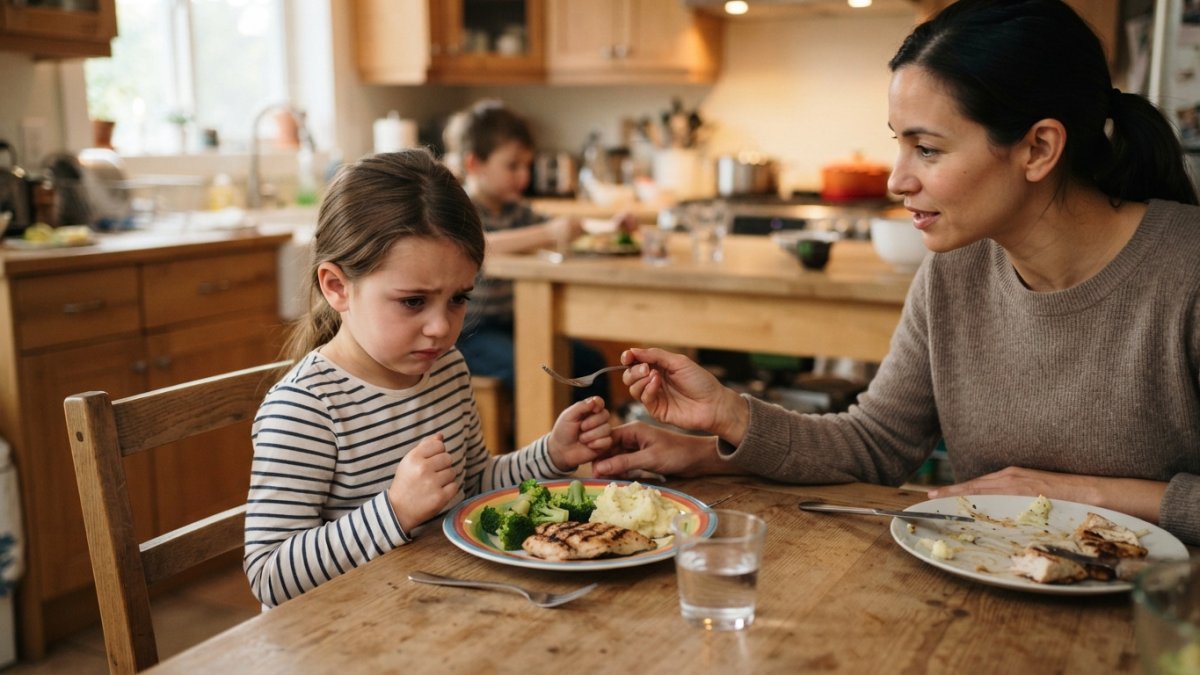
Dinner time anxiety in children is a fear response around meals that goes well beyond ordinary fussiness. Managing dinner time anxiety in children starts with recognizing the child is not refusing food to be difficult, the child feels nervous, and that nervousness makes the table stressful for everyone.
This guide covers how to spot dinner time anxiety, reduce pressure at the table, and when to bring in outside help.
Common signs and triggers at the dinner table
Anxiety at dinner often looks different from a child who simply wants their own way. Watch for these patterns:
- Crying, gagging, or leaving the table before eating starts
- Refusing foods the child has eaten before, especially after a bad day
- Asking repeatedly whether a food is "safe" or what is in it
Common triggers include a crowded or noisy table, a new food placed in front of them, pressure to "just try one bite," comments about how much they ate, and a rushed or unpredictable routine. Sensory sensitivity to texture, smell, or temperature can also set off a stress response before the first bite.
How anxiety differs from ordinary picky eating
Ordinary picky eating is common and often improves with time. Persistent resistance often stems from a deeper fear of trying new things that requires patient, incremental exposure to help the child regain a sense of safety at the table.
A helpful test: if the child is calm when the food is out of sight and becomes upset as soon as it appears, anxiety may be part of the picture. The American Academy of Pediatrics guidance on feeding concerns offers general information on when to raise these concerns with a pediatrician.
How to Reduce Stress at Mealtimes With Kids
The fastest way to lower dinner time anxiety is to take pressure off the table. Most children eat better when the meal feels safe and predictable.
A calm table usually has a few features in common:
- A regular meal time and a short, set meal length
- Familiar foods served next to any new food
- No forced bites, bribes, or threats
Keep a meal routine steady from day to day. Children with anxiety often feel safer when they know what comes next.
Some families find that dips or sauces make new foods feel less threatening.
A Step-by-Step Plan for an Anxious Dinner
Most mealtime advice stops at "stay calm and don't force bites," which is not enough when a child is genuinely anxious. Anxious children need a predictable script the parent follows the same way every night, so the child can predict what happens next and their nervous system can settle. The plan below is organized as before, during, and after dinner, with a separate reset protocol for an acute episode.

Before dinner: set the stage (10 to 15 minutes ahead)
- Announce the meal once, calmly. Say, "Dinner is in ten minutes." Avoid repeated warnings or countdowns, which build dread.
- Let the child see the plate before sitting. Place one familiar food and one small portion of a new food on the plate, uncrowded. A plate with five items reads as a threat to an anxious child; two or three reads as manageable.
- Keep the sensory environment steady. Lower the noise (turn off the TV, reduce overlapping conversation), keep lighting even, and seat the child in the same chair each night. Predictability stops the brain scanning for surprises so it can focus on the food.
- Do a two-minute regulation activity. A drink of water, a short walk to the table, or three slow breaths together gives the child a transition buffer. This is a routine step, not a reward or a bargain.
During dinner: follow the script
- Sit and start with non-food talk. Ask about the day or tell a short story; the first two to three minutes should have zero food commentary.
- Narrate, don't direct. Instead of "Try the broccoli," say, "There's broccoli on the table." Descriptive language keeps pressure low and gives information without an instruction.
- Use the "look, touch, taste" ladder. Invite the child to look, then touch, then lick, then taste, in that order, and accept whatever rung they stop at. Children move up the ladder over repeated meals, not within a single one.
- Praise the process, not the bite. "You touched the carrot" or "You smelled it" reinforces exploration. Avoid "Good job eating," which teaches that eating is the only acceptable outcome.
- Keep the meal to about 20 to 30 minutes. When time is up, end it calmly regardless of how much was eaten. A predictable ending teaches the child the meal has a boundary and they are not trapped at the table.
After dinner: close the loop
- Note what happened in one or two lines. Record the foods served, what the child did (looked, touched, tasted, ate), and anything that seemed to trigger distress. Patterns usually emerge within one to two weeks, and the notes become useful data if you later consult a pediatrician or feeding therapist.
- Do not re-offer the meal as a rescue. If the child ate little, offer the next scheduled snack or meal rather than a replacement favorite food. Replacing the meal teaches that refusal leads to a preferred food, which raises anxiety-driven avoidance over time.
What to do during an acute anxiety episode
If the child cries, freezes, gags, or escalates at the table, switch from the script to the reset protocol:
- Pause the meal, not the child. Say, "We can take a break," and stop eating yourself. Do not negotiate, bargain, or repeat the instruction.
- Lower the demand to zero. Remove the plate from the child's immediate space if they want it gone. The goal is to reduce the threat, not win the moment.
- Offer a calm space and a choice. "Do you want to sit on the couch or take a walk?" A choice restores the sense of control anxiety has taken away.
Adjust for age
- Toddlers (1 to 3): Keep the meal to 15 to 20 minutes, expect mess, and treat touching and throwing as exploration rather than misbehavior. Keep language-based steps short and concrete.
- School-age children (4 to 11): The look/touch/taste ladder and process praise work well. Involve the child in choosing one new food per week and in simple prep tasks, which builds ownership.
- Teens: Anxiety at dinner often shows up as irritability or withdrawal rather than tears. Offer a seat at the table without forcing conversation about food, and let the teen serve themselves from shared dishes so portion control stays in their hands.
Explore the options on the Tiny Wins site to choose a blend.
What to Say to a Picky Eater (and What to Avoid)
The words you use at dinner shape how a child feels about food. Simple, calm language usually works best.
Try saying:
- "You can taste it or just look at it. Either is fine."
- "This is a new food. Our family is still getting to know it."
- "Tell me one thing you notice about the color."
Avoid saying:
- "Just one bite and you can have dessert."
- "You'll sit here until you finish."
- "Other kids eat this, why can't you?"
Threats and bribes raise anxiety and make new foods feel more dangerous. Neutral, brief comments keep the focus on the family rather than the plate.
Here is a quick reference for the phrases that help and the ones that raise anxiety at the table.
Try saying |
Why it helps |
Avoid saying |
Why it hurts |
|---|---|---|---|
"You can taste it or just look at it." |
Gives a choice with no pressure |
"Just one bite and you can have dessert." |
Bribes make new foods feel more dangerous |
"This is a new food. Our family is still getting to know it." |
Frames the food neutrally |
"You'll sit here until you finish." |
Threats raise anxiety |
"Tell me one thing you notice about the color." |
Shifts focus to observation |
"Other kids eat this, why can't you?" |
Comparison adds shame |
Food Exposure Activities for Children Who Feel Nervous About Food
Food exposure means letting a child interact with food in low-pressure ways. Many children need a dozen or more gentle exposures before they eat a new food, so patience matters.
Easy activities to try:
- Wash vegetables together at the sink
- Stir a sauce or sprinkle cheese on a dish
- Sort foods by color or shape on a plate
Keep each activity short and optional. The goal is comfort, not a finished meal. A child who touches a new food has made progress, even if they do not eat it.
When to Seek Help for Picky Eating and Mealtime Anxiety
Most dinner-time anxiety improves with a steady routine and reduced pressure. But some patterns need professional input, and waiting too long can make the problem harder to treat. Use the criteria below to decide whether to raise the issue with your child's doctor.
Warning signs that warrant a call to the pediatrician
- Growth or weight concerns. Weight loss, a drop across growth percentile lines, or failure to gain weight as expected over several months.
- A very narrow diet. A common threshold is fewer than 15 to 20 accepted foods, especially if the list is shrinking rather than growing.
- Physical symptoms at meals. Gagging, choking, coughing, or vomiting during eating, or complaints of pain when swallowing.
Distinguish the likely cause before you book
Dinner-time anxiety is not one thing. The right professional depends on what is driving the behavior:
- Sensory-driven avoidance. The child reacts to texture, smell, temperature, or mixed textures (for example, a food with sauce on it) rather than to the food itself. An occupational therapist with feeding experience is often the right first referral.
- Medical or gastrointestinal causes. Reflux, constipation, food allergies, eosinophilic esophagitis, or swallowing difficulty can make eating painful, and a child who has been hurt by food learns to fear it. Start with the pediatrician, who can screen and refer to a pediatric gastroenterologist if needed.
- Anxiety-driven avoidance. The child asks whether foods are safe, worries about choking or vomiting, or becomes distressed as soon as the plate appears even when the food is familiar. A child psychologist or therapist trained in cognitive behavioral therapy for anxiety is usually the best fit.
Who to see, and what to ask for
Ask your child's doctor for a referral to a pediatric feeding therapist (often a speech-language pathologist or occupational therapist), a child psychologist, or a registered dietitian with pediatric feeding experience. When you call, ask three questions: Do you treat anxiety-driven feeding avoidance, not just picky eating?
A pediatrician can check growth, screen for medical causes, and coordinate referrals. The American Academy of Pediatrics guidance on feeding concerns offers general information on when to raise these concerns with a pediatrician, and the National Institute of Mental Health information on childhood anxiety explains common anxiety symptoms and when families should seek support.
What to do while you wait for an appointment
Keep the before/during/after routine from the plan above in place, continue offering familiar foods alongside new ones without pressure, and keep notes on what the child ate and what triggered distress. Those notes give the clinician a clear picture and often shorten the assessment process.
Booking Your Child's Next Steps With a Feeding Professional
A feeding professional can build a plan that fits your child's sensory profile, medical history, and daily routine. Ask your child's doctor for a referral to a pediatric feeding therapist, occupational therapist, or child psychologist.
Browse the nutrition options on the Tiny Wins site to see which blend fits your child's needs and daily meals.
Frequently Asked Questions
Why does my child get anxious at dinner time?
Dinner anxiety often comes from a mix of factors: sensory sensitivity to textures or smells, pressure from adults to eat, a long or unpredictable meal, or a past experience of gagging or feeling unsafe while eating. Some children also feel overwhelmed by the social side of a family meal. Noticing what seems to set off the anxiety, such as a specific food, a time of day or a particular comment, helps you address the actual cause rather than only the behavior at the table.
What should I do when my child refuses to eat dinner?
Stay calm, keep the meal short and avoid bargaining, bribing or forcing bites, since pressure usually increases anxiety. Serve a small portion of a familiar food alongside one new or non-preferred food, and let your child decide how much to eat. If refusal continues for many meals or your child's growth or energy seems affected, talk with your pediatrician rather than trying more tactics at the table.
How can I help a picky eater feel more comfortable trying new foods?
Repeated, low-pressure exposure works best. Put a new food on the table without expecting it to be eaten, pair it with a familiar favorite, offer one small bite or a taste on a separate plate, and praise effort such as touching or smelling the food. A child may need many exposures before accepting a food, so progress is measured in small steps rather than full servings.
When should I seek help for my child's mealtime anxiety?
Consider professional help if mealtimes regularly end in tears or vomiting, if your child eats only a very small list of foods, if weight gain or growth slows, or if anxiety spreads to other parts of daily life. A pediatrician can check for medical causes, and a feeding therapist or child psychologist can help with sensory and anxiety-related eating difficulties.



Leave a comment
This site is protected by hCaptcha and the hCaptcha Privacy Policy and Terms of Service apply.